Background
The USD/JPY exchange rate recently reached a 40-year high of 163 yen per U.S. dollar, then moved back to 156 following intervention by regulators.
I bought my first put against the Nasdaq Composite (a QQQ September 30, 2026, $660 put) on July 28, 2026, because I had become wary of the U.S. economy.
At that point, the chair of the Federal Reserve, Kevin Warsh, had held two rate-setting meetings, yet he had not clearly provided rate guidance for the coming months.
My impression was that the broader stock market had already priced in the possibility that the Fed would raise rates to curb inflation, causing the Nasdaq to fluctuate between roughly 24,000 and 26,000 points. My put was simply a way to hedge against market volatility and protect my portfolio, much like insurance. As a result, I found that my hedge was relatively successful: QQQ fell to 660 briefly in after-hours trading on July 29, then quickly returned to 670, thanks to Microsoft's impressive earnings report.
Over the next two days, the yen weakened to 163 yen per U.S. dollar at one point. The Nasdaq Composite briefly reacted to the yen's depreciation.
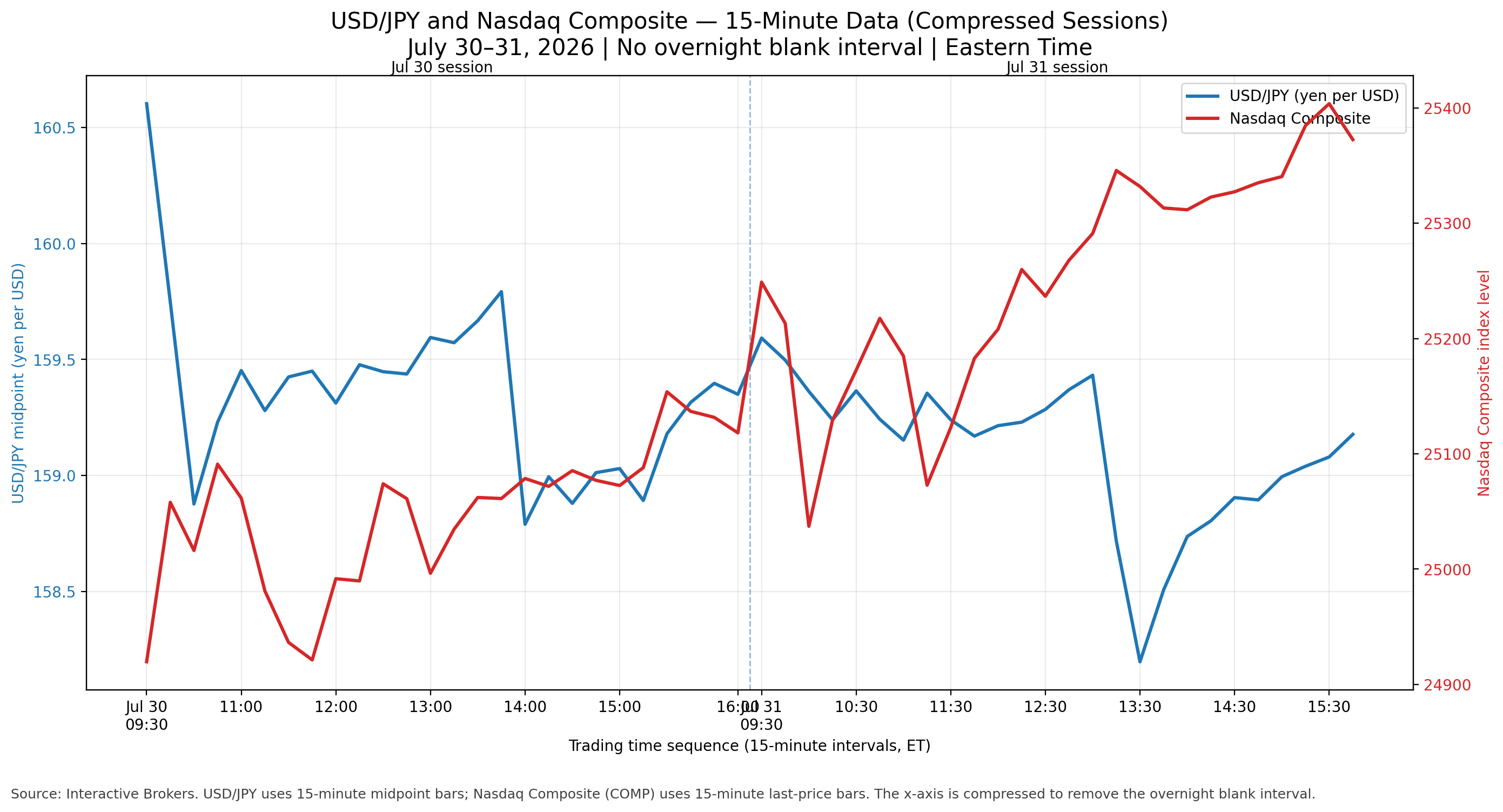
A sudden 300-point drop in the Nasdaq is significant, yet the index has experienced several similar intraday corrections.
Yen Carry Trade (Free Money)
The Japanese government has kept interest rates low. Therefore, borrowing yen when the yen is strong and repaying it when the yen is weak can result in a profit.
Let's look at an example:
Borrowing ¥1 million at a 1% interest rate when the exchange rate is 156 yen per U.S. dollar would provide approximately $6,410 when converted.
Investing it in the U.S. stock market and earning a 5% return would bring the total to approximately $6,730.
Repaying the loan when the yen is weaker (at 160 yen per U.S. dollar) would require approximately ¥1.07 million, leaving a net gain of about ¥60,000 after interest.
Joint Intervention
1. Direct yen-buying intervention by Japan
Japan sold foreign-currency assets and bought yen in the foreign-exchange market. The decision was made by Japan’s Ministry of Finance, while the Bank of Japan executed the transactions as the Ministry’s agent.
The Bank of Japan’s money-market data suggested that Japan may have spent approximately US$59 billion during the first operation and up to an additional US$36.6 billion during a subsequent operation. These figures were market estimates; the definitive intervention amounts are released later by Japan’s Ministry of Finance.
2. Coordinated intervention by the United States
The U.S. Treasury also purchased yen as part of a coordinated intervention with Japan. The operation was executed through the Federal Reserve Bank of New York.
According to reports citing people familiar with the transactions, the New York Fed sold euros and purchased yen on behalf of the U.S. Treasury. Goldman Sachs and Morgan Stanley were reportedly used as executing dealer banks, although they were acting as intermediaries rather than independently directing the intervention.
3. Advance coordination with major financial institutions
Before the intervention, the U.S. Treasury, through the New York Fed, reportedly informed several major foreign-exchange banks that they should be prepared for possible official yen purchases.
This helped ensure that the authorities could execute large transactions quickly and obtain sufficient market liquidity.
4. Verbal intervention and warnings of further action
Japanese and U.S. officials publicly described the yen’s movements as excessive or disorderly and indicated that additional intervention could occur if necessary.
These warnings increased the risk of maintaining speculative short-yen positions and discouraged traders from continuing to sell the currency aggressively.
5. Potential dollar-liquidity support
Japan could also use the Federal Reserve’s Foreign and International Monetary Authorities Repo Facility, or FIMA Repo Facility, as a dollar-liquidity backstop.
Under this facility, an eligible foreign official institution can temporarily exchange U.S. Treasury securities for dollars through a repurchase agreement. This could allow Japan to obtain dollars for intervention without permanently selling large quantities of U.S. Treasury securities.
However, publicly available information does not conclusively establish that Japan used the FIMA facility during these particular intervention operations. The facility should therefore be understood as a potential supporting mechanism rather than a confirmed transaction.
6. Forced unwinding of speculative positions
The official yen purchases triggered additional private-sector buying. Hedge funds, commodity trading advisers, and other investors that had shorted the yen or used yen-funded carry trades were forced to buy the currency back as the exchange rate moved against them.
This short covering amplified the initial impact of the government intervention. It was a market reaction rather than a separate government measure.
Aftermath
The immediate aftermath for the U.S. Treasury market has been mildly positive for bond prices, but the yen intervention was not the main reason Treasury yields fell today.
The immediate market reaction on August 3 was:
- The 10-year Treasury yield fell about 6 basis points to 4.684%.
- The 30-year yield fell about 5 basis points to 5.227%.
- Treasury’s official end-of-day curve showed yields of approximately 4.70% for the 10-year and 5.23% for the 30-year maturities.
The current operation appears designed partly to protect the U.S. Treasury market from disorderly Japanese selling.
So far, the results are:
Lower immediate Treasury-market stress, no confirmed large-scale Japanese liquidation, and modestly lower yields—but today’s decline in yields was driven primarily by falling oil prices.
The larger danger is not this intervention itself. It is a future combination of:
- a stronger yen;
- rising Japanese bond yields;
- BOJ tightening;
- Japanese investors repatriating funds from U.S. bonds.
That scenario would be much more consequential for the 10-year and 30-year Treasury markets than a single foreign-exchange intervention.
Reference: